



Why Pakistan
Home >> Why Pakistan >> Textile Sector
Textile Sector
Pakistan is the 8th largest exporter of textile products in Asia, being the 7th largest producer and 3rd largest consumer of cotton. The sector comprises 46% of the total manufacturing sector’s output and provides employment to 40% of the total labor force. This sector’s overall GDP contribution is 5.6%. Textile and Apparels’ sector is the biggest contributor in manufacturing with its immense potential for investment in value addition. Approximately 25% of value addition in the industry is by textiles with an average of 59.5 percent share in national exports.
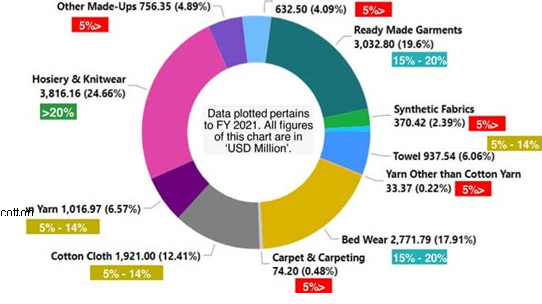
Export breakdown by different categories
Pakistan has a supply base for almost all man-made and natural yarns and fabrics,including cotton, rayon and others. This abundance of raw material is a big advantage for Pakistan due to its beneficial impact on cost and operational lead time. Pakistan has the complete value chain in textile from cotton to ginning, spinning, fabric, dyeing and finishing, made-ups and garments. To realize the textile sector’s full potential, Pakistan has launched its Textiles and Apparel Policy 2020-25.
The industry comprises 13.41 million spindles, 140,000 rotors, power looms 375,000 and 28,500 shuttle less looms.Industry is majorly located in three cities; Lahore, Faisalabad and Karachi.The textile industry comprises 408 textile units (40 composite units and 368 spinning units) around 3 Billion Kgs production of yarn annually.
There are around 1,200 cotton ginning units in the country.Ready made garments market will register a CAGR of 8.8% from 2021 to 2027 and will reach $1 268.3 billion by 2027.Pakistan has more than 200 companies which manufacture technical textiles, composites and non-wovens.
Advantages of investing in this sector in Pakistan:
Skilled Labour: Efficient, trained and low cost labor which already constitutes about 40% of the total industrial workforce in the country.
Well established end to end textile value chain: Pakistan has a complete value chain from fiber to fabric in Pakistan.
Enhanced Govt Support: Textile industry contributes 60% of national exports making it the most important industry. Government has devised a textile policy to provide support through tax concessions.
European Union’s GSP + status: GSP+ in 2014 has given Pakistan a competitive edge as it is the second country in South and South East Asia to have duty free access to the EU. Pakistan leverages a 10- 14% duty advantage.
Strong Supply of Raw material: Pakistan is the 7th largest cotton producing country and has a supply base for almost all man made and natural yarns and fabrics.
Growing urban population: An expanding working class, rising socio-economic quotient, increase in number of working women, along with awareness about brands, styles and designs are adding to the domestic demand for branded textile products and apparel (woven and knitted) in the country.
Incentives
- Duty Free Import of machinery & equipment.
- Exemption of Sales tax on Import of machinery & equipment.
- Long Term Financing Facility (LTFF) at Concessional Rates.
Export Finance (EFS) available at a concessional rate of 3.0%.
Permission to import restricted items by manufacturers.
Fully automated system for Repayment of customs–duties to exporters.
Zero Custom Duty for textile products for export to China.
Low tariff/exemptions on exports to countries of EU due to GSP+ status.
Export facilitation Scheme 2021.
